
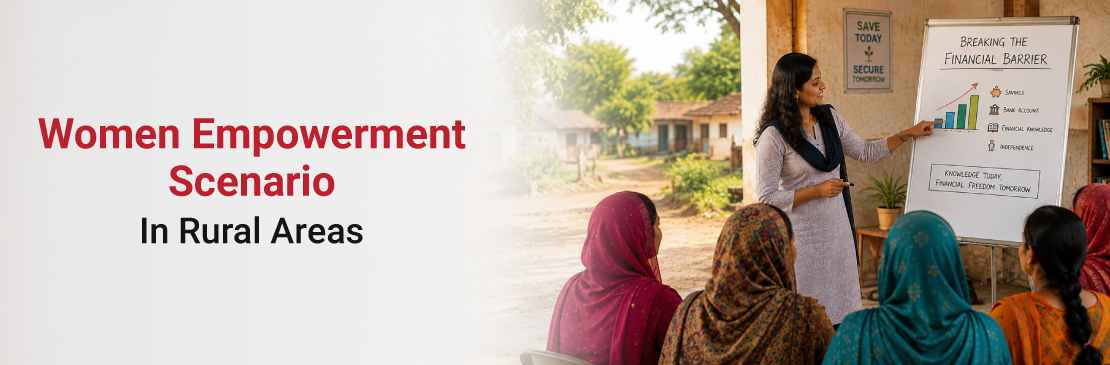
Women Empowerment Scenario In Rural Areas
Women in rural India have always contributed to the economic well-being of their families. They work in agriculture, construction, small businesses, handicrafts, food processing and paid labour. Many women are also members of self-help groups (SHGs), where they save money, access credit and take part in livelihood activities.
Yet, there is a difference between earning money and having control over money.
This is why financial literacy deserves a stronger place in discussions about Women Empowerment in rural areas.
Rural Women Are Already Part Of The Economy
The economic participation of rural women is significant. According to recent data from India's Periodic Labour Force Survey, Among the 15 years and above age group, female WPR improved to 38.4% in February 2026 as compared to 36.8% in April 2025 in rural areas.
Their contribution, however, is not always matched by financial decision-making power.
A woman may earn a daily wage and hand most of it over for household expenses. She may save a small amount but have no idea how to make those savings useful in the long term. She may take a loan without fully understanding the interest or repayment conditions.
This situation shows why empowerment has to go beyond employment.
Financial Inclusion Has Improved
India has made considerable progress in bringing rural women into formal financial services.
The Deendayal Antyodaya Yojana-National Rural Livelihoods Mission has brought 10.05 crore women into around 92 lakh self-help groups. These groups have become important channels for savings, credit, livelihoods and financial inclusion.
Financial literacy is also being included in these efforts.
During 2025-26, more than 3.81 crore women SHG members received financial literacy training in areas such as savings, credit, insurance, pensions, financial planning and enterprise financing.
These figures show that access to financial services is improving. But access alone does not guarantee understanding.
The Biggest Problem Is Often Time
A common approach to financial education today is to use digital content. People can learn through videos, podcasts, online courses, mobile applications and social media.
For many rural women, however, this approach is not always practical.
Some may not have a smartphone or reliable internet connection. Others may not be comfortable using digital platforms. Even when technology is available, there is another problem that is often overlooked: time.
Imagine a woman who leaves home in the morning for paid labour. She spends several hours working and returns home to prepare food, clean the house, take care of children and handle other family responsibilities.
Asking her to watch a one-hour financial education video may seem reasonable. But finding that one hour can be difficult.
If she is asked to attend an offline workshop during working hours, the problem becomes even more serious. She may have to give up paid work to attend it.
For a woman whose family depends on daily earnings, missing work is a real financial cost. Here’s how we can fit into the everyday lives of rural women.
1. Daily Wage Workers
Women who are daily wage earners may see losing a day as equivalent to not getting their wages. However, such short sessions can be scheduled either via self-help groups or by using the facilities of local community organisations at work hours.
2. Limited Internet
Some women can't own a smartphone or may not have a good Internet connection. Learning materials on paper, resources available in local language, offline sessions and basic audio lessons can help them learn without relying on the Internet.
3. Time is limited
Women who are doing their job and also have house responsibilities, such as, for instance, preparing food, taking care of the children and doing chores. By providing them with short and single-topic sessions, it would be easier for these women to integrate the learning into their schedule.
4. Lack of Financial Confidence
Some women might feel uncomfortable asking questions about money or making financial decisions. Providing a supportive environment to discuss real-life money issues can help them learn the basics and feel more confident about how to manage their finances.
How Finance Buddy for Women Can Support This Journey
This is why offline financial literacy for women programmes continues to have an important role in rural areas.
Team Lakshme - Finance Buddy for Women is working to make financial literacy more accessible through workshops.
The workshops are intended to help women understand money in a simple and practical way. The idea is not to bombard participants with financial jargon or complicated ideas. Instead, the sessions begin with the basics that women can relate to in their everyday lives.
A woman should be able to learn about budgeting, saving, banking, insurance, loans and investments in a way that connects with her daily life.
A Practical Path Towards Empowerment
Rural women are already working and contributing to India's economy. The country has also made significant progress in providing women with access to bank accounts, self-help groups, credit and financial services.
The next step is to make sure that women can actually understand and use these opportunities.
The real financial empowerment is when a woman begins to do more than earn and save money. She should be aware of her income, manage her expenses, protect her savings and make informed decisions about her financial future.
That is what can turn financial inclusion into genuine women empowerment in rural areas.

Do you have any questions? Write to us
 Do_thumbnail.PNG)